


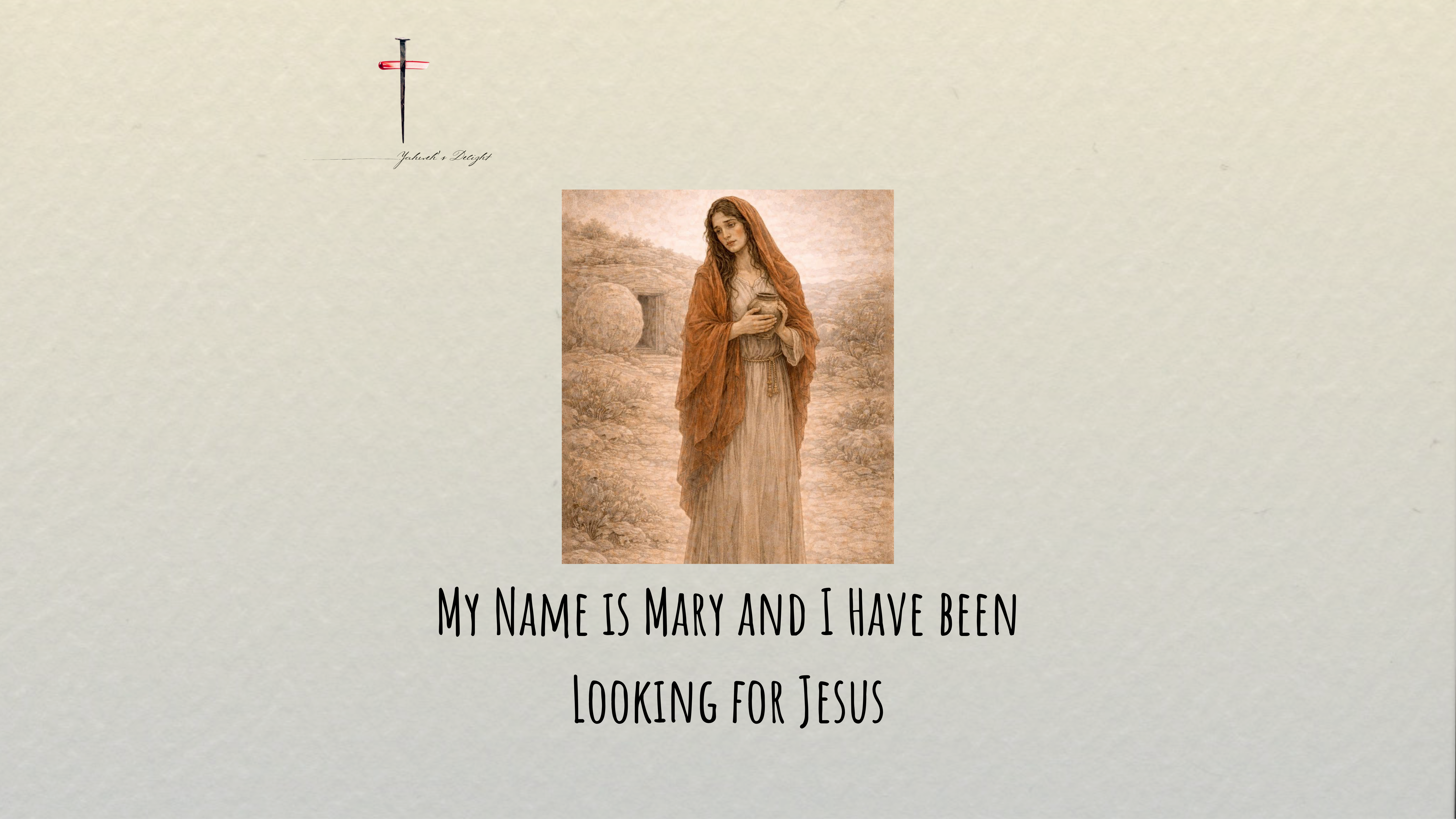
“Woman, why are you weeping? Whom are you seeking?” John 20:15
My name is Mary.
Mary of Magdala, they call me, to separate me from the others, because there are always others named Mary. It is that kind of name – common. Mary of Magdala, the one from the fishing town on the western shore of the lake.
You may have heard things about me.
Some of them are true.
What I want to tell you about is not my past. My past is not the most interesting thing about me, no matter what anyone has told you. What I want to tell you about is three days in Jerusalem that remade me so completely that I am not sure the woman who walked into that city on Thursday evening still exists.
She doesn’t, actually and let me tell you why.
FRIDAY
I have been following Him for two years.
I want you to understand what that means, because in our world, in this time, women do not do this. Women do not leave their towns and follow a rabbi from Galilee across the countryside. Women do not sit at the feet of teachers. Women do not fund ministries, which we did, quietly, several of us. Luke records it without apology: Mary Magdalene, Joanna, Susanna, and many others… were helping to support them out of their own means (Luke 8:2-3). There we are. In the text. Funding the mission and present from the beginning.
We did all of it because of what He did for me.
I will not go into detail. I will only say that before I met Him I was not free. Luke records it: seven demons had gone out of her (Luke 8:2). Seven. That number means there was no part of me that was not occupied by something that was not me. Something I had no power over and no language for and had lived with so long I had stopped believing there was a version of me without it.
He looked at me and He spoke and it left and I have been following Him ever since.
Not out of obligation or guilt but out of the only reasonable response to someone who gave you back yourself, your life, your sanity. I followed the one who restored me completely.
Now it is Thursday night and something is wrong.
I feel it before I understand it. The air at the Passover meal is heavy in a way I cannot explain. He washes the disciples’ feet, which confuses everyone and moves several of them to tears. He speaks about going somewhere they cannot follow. He speaks about a betrayer. He tells Simon Peter: where I am going, you cannot follow now, but you will follow later (John 13:36). He speaks as a man who knows exactly what would happen in the next twelve hours.
And then Judas leaves the table and something in the room shifts and does not revert.
John records the moment with a detail that has haunted me ever since: And it was night (John 13:30). Just that. Judas went out and it was night. As if the darkness outside was responding to what had just walked into it.
I do not sleep.
Everything that happened felt like a blur. I was in the moment and experienced every single emotion known to man. From hearing of his arrest to following at a distance, the way women must do everything, to hearing the crowd choose Barabbas. And then they brought Him out and I saw Him and my hand flew to my mouth before I could stop it. I almost did not recognize Him and that shattered my heart.
Isaiah had written it centuries before this morning: his appearance was so disfigured beyond that of any human being and his form marred beyond human likeness (Isaiah 52:14). I did not know those words then. I know them now and every time I read them I am back on that street, hand over my mouth, unable to make a sound because if I start I will not be able to stop.
He falls under the weight of the crossbeam. They pull a man from the crowd, a visitor named Simon from Cyrene, coming in from the country with no idea what is about to be placed on his shoulders (Mark 15:21). He carries it the rest of the way.
I watch Jesus walk behind this stranger. And at one point He looks up and His eyes find mine in the crowd.
There is a Roman centurion who was there that day. He saw that look too. He stood at the foot of the cross for the entire six hours and he narrates what happened in far greater detail than I can bear to. You can read his account here.
What I will tell you is where I was at the end of it.
I follow them and Matthew records it simply: Mary Magdalene and the other Mary were sitting there opposite the tomb (Matthew 27:61).
That was me, sitting in the dirt opposite the sealed stone. The others eventually come and touch my shoulder gently. It is late and it is Sabbath. We must go but we will come back. We will bring more spices and we will do this properly.
I let them lead me away.
I look back at the stone and I do not know that I am looking at the most important address in the world.
I only know that He is in there. My Lord is in there and I am out here.
And the distance between those two things is the largest distance I have ever felt.
SATURDAY
I do not know how to describe Saturday.
Have you ever had a grief so large it has no edges? You cannot find where it begins and where you begin. It is not a feeling inside you, it has swallowed you and you are inside it.
That is Saturday.
I move through the day the way you move through deep water. The other women are with me and we do not say much. We prepare the spices and the perfumes, Luke writes about it (Luke 23:56), because our hands need something to do when our hearts have nowhere to go.
I keep thinking about His eyes finding mine in the crowd.
I keep thinking about what was in them. That steadiness – that terrible, beautiful steadiness.
I do not understand it. I roll it over and over in my head. A man going to His own death who looks at the people He loves with steadiness rather than fear. Who says from the cross Father, forgive them, for they do not know what they are doing (Luke 23:34). Who in His final breaths makes sure His mother will be cared for. Who gives paradise to a dying criminal with what little breath He has left.
Who has that much left to give when they have nothing left?
I think I know the answer but the stone is rolled across it and the Sabbath is very long and very quiet and night comes again and I do not sleep.
Tomorrow, I tell myself.
Tomorrow we go back and tomorrow I can at least be near Him again. It is the only tomorrow I can hold in my mind. Not a hope, just a direction. Just: tomorrow. The tomb. The spices. Near Him.
I can do tomorrow.
SUNDAY
I am up before dawn.
Mark records who is coming: Mary Magdalene, Mary the mother of James, and Salome (Mark 16:1). We have bought more spices. We are going to anoint Him properly, which we could not do before the Sabbath. We are going to finish what Joseph and Nicodemus started in a hurry.
I am ahead of the others. I am always ahead of the others.
I am walking fast and thinking practically because practical thinking is the only container that holds me together right now. Who will roll the stone away. It is too heavy for us alone. Mark records that we are asking each other this on the way: Who will roll the stone away from the entrance of the tomb? (Mark 16:3). We do not have an answer. We are going anyway.
I arrive and I stop in my tracks.
The stone is already moved.
I stand very still and look at it. The stone that was sealed with guards posted. Matthew records what happened, which I only piece together later: an angel of the Lord had come down, his appearance like lightning, his clothing white as snow, and the guards had shaken and become like dead men (Matthew 28:2-4).
All I see is the open tomb.
I do not go in.
I run and I find Peter and John and I am barely coherent. The words come out wrong: They have taken the Lord out of the tomb, and we don’t know where they have put him (John 20:2).
They run and I run after them. John is faster and arrives first and stops at the entrance and looks in. He sees the strips of linen lying there (John 20:5). Peter goes straight in, because Peter has never in his life stopped at the entrance to anything. He sees the linen as well, and the cloth that had been around Jesus’s head, not lying with the linen but folded up by itself, separately (John 20:6-7).
I arrive last and I stand outside the tomb and I am weeping. Fully weeping now, the way I have been holding back since Friday. Because on top of the grief of losing Him, I now have this, the not knowing where He is, the not being able to be near Him even in death, which was the only thing I had left.
Peter and John come out. John records that he saw and believed (John 20:8), though they did not yet understand that Jesus had to rise from the dead (John 20:9). They go back to the others.
And of course I stay. I am always the one who stays.
I am outside the tomb weeping and at some point I do the thing you do when grief has nowhere left to go. I bend down and look in.
Two figures inside. Seated where the body was, one at the head and one at the feet (John 20:12). Like they are keeping the shape of something that is no longer there.
They ask me: Woman, why are you weeping?
And I say, through my tears, through my absolute wreckage: They have taken my Lord away, and I don’t know where they have put him (John 20:13).
I do not question who they are. I am too far inside my grief to be frightened by the strange things. Grief does that. It makes the extraordinary ordinary because you are already living in something extraordinary and terrible.
I straightened up just like He did.
And there is someone standing in the garden behind me.
I think He is the gardener.
I want you to sit with that for a moment because it is not a stupid mistake. It is barely light and I am weeping so hard I can barely see. There is no category in my mind yet for what has actually happened. The most natural explanation for a man in a garden at dawn is that he belongs to the garden.
He asks me the same question: Woman, why are you weeping? Whom are you seeking? (John 20:15).
And I think, through my tears, through my practical desperate grief: perhaps this man knows something. Perhaps he moved the body.
Sir, if you have carried him away, tell me where you have put him, and I will get him (John 20:15).
I will get Him.
Not: tell me and we will make arrangements. Not: tell me and I will send someone. Tell me and I will get Him. Myself. This woman, alone, at dawn, will somehow carry a wrapped body from wherever it has been taken to wherever it should be.
This is what love looks like when it has lost all reason. This is what two years of following Him produces in a person. Logic has left the building and all that remains is: I will find Him. Just tell me where.
And then, He says my name.
Mary (John 20:16).
One word. Just my name.
And I have heard my name thousands of times. From my mother, from the women I travel with, from the towns we passed through on the road. Mary. A common name.
I have never heard it like this.
He says it the way He always said it and I know, I know before I have turned around, I know in the place that is deeper than thought and faster than reason, I know before my eyes confirm it. I know in my bones and my blood and the soles of my feet.
I turn.
Rabboni (John 20:16).
Teacher.
It is the only word I have and everything I have. Two years of following and watching and being remade and losing and grieving and weeping in a garden at dawn, compressed into one word.
Teacher.
I reach for Him.
Every cell in my body reaches for Him. I have been looking for Him since Friday and He is standing in front of me alive and breathing and the instinct to grab hold and never let go is so overwhelming that He has to say it gently:
Do not hold on to me, for I have not yet ascended to the Father (John 20:17).
Not because He does not want to be near me. But because something is different now. He is the same and He is different. Present and not containable. Here and also going somewhere that holding on cannot reach.
And then He says the thing that restructures everything.
Go instead to my brothers and tell them: I am ascending to my Father and your Father, to my God and your God (John 20:17).
He is sending me.
Me, Mary of Magdala. The one with the history. The woman who could not sit at the table on Thursday night. The woman who had to follow at a distance because that was the space the world gave her. The woman who stayed at the cross when the men scattered. The woman who came to the tomb before dawn with spices and a practical problem she had not solved yet.
He is sending me to the disciples. To Peter, who denied Him. To the men behind locked doors, trembling (John 20:19).
He is sending a woman.
In a world that did not count a woman’s testimony in a court of law, in a world that would give her story every reason to be doubted, He chose me. The first witness to the resurrection is not a priest, not a disciple, not a man with credentials and a reputation for credibility.
It is Mary of Magdala.
The one He gave back to herself. The one who stayed and so, I run.
I am not a young woman and I do not care. I run through that garden in the early morning light and everything is golden and the birds are doing what birds do in the morning and the world is a completely different world than the one I woke up into and I am running through it with a message that has never been delivered in human history before this moment.
I arrive breathless and I look at these frightened hiding men. And I say the words John records: I have seen the Lord (John 20:18).
I have seen the Lord.
Five words. The hinge on which all of human history turns.
They will question me. Some of them will not believe me immediately. Luke records it plainly and without softening it: they did not believe the women, because their words seemed to them like nonsense (Luke 24:11). Even now. Even here. At the most important moment in history, a woman’s testimony is called nonsense.
And yet.
Here we are. Two thousand years later. Reading her words. In every language. On every continent. In every kind of darkness people have found themselves sitting in.
He chose right.
He always chooses right.
My name is Mary.
I was not free before I met Him, and He freed me.
I followed Him for two years, at a distance, at the margins, in the spaces the world permitted me to occupy.
I watched Him die on a Friday and I did not look away.
I sat in the dirt outside His sealed tomb and I could not leave.
I came back before dawn on Sunday with spices and a practical problem and no category in my mind for what I was about to walk into.
And in a garden, in the early morning, He said my name.
Just my name and the whole world rearranged itself around that one word.
Isaiah had written, seven hundred years before that garden: he has sent me to bind up the brokenhearted, to proclaim freedom for the captives and release from darkness for the prisoners (Isaiah 61:1). Jesus had stood in the synagogue in Nazareth and read those words out loud at the beginning of His ministry and said: Today this scripture is fulfilled in your hearing (Luke 4:21).
I am the fulfillment of that scripture with skin on.
I was captive and He released me.
I was broken and He bound me up.
I was in darkness and He called me by name into the light.
And then He sent me running.
This is the part that still takes my breath away, even now, even all this time later.
The tomb could not hold Him. Death could not hold Him.
The sealed stone and the Roman guards and the silence of Saturday could not hold Him.
And in two thousand years of telling this story, in every language on earth, across every ocean and every century and every kind of loss people have endured, one thing has remained constant.
He finds the ones who are looking for Him.
He finds them in the garden of their grief. In the barely-light of their before-dawn. In the moment they have run out of categories for what is happening and are standing outside an empty place where they expected to find death and have found instead something they have no word for yet.
He calls them by name. Their own name, not a title or a category. Their name, the one their mother gave them, the one worn smooth by years of ordinary use.
And when He says it, everything changes.
She turned toward him and cried out (John 20:16).
That turning is the whole gospel.
Turn toward Him.
He is already there.
He is saying your name.
My Lord is your Lord. My Love is your Love. My Rabboni is your Rabboni.
And if He is not yet, He wants to be. That was the whole point of everything I have just told you. The garden, the nails, the darkness at noon, the folded linen and the stone rolled away.
None of it was accidental and none of it was only for me. It was the Father’s plan to bring you back to Himself, and Jesus was the only one who could walk that road, and He walked it willingly, all the way to the end, for you specifically, for this moment specifically, for the version of you that is reading this right now.
Two thousand years of this story being told and it has found you today.
That is not a coincidence.
The one who found me in the dark, who said my name when I thought all was lost, who turned death itself inside out before breakfast on a Sunday morning.
He is not finished, He is risen and He is calling. And He already knows your name.
Go to Him.
Leave a Reply